
FIDO: Impact, Time of Day, Hold Down attributes
what it means:
Alarms will be present in the FIDO database, but may be presented to the user in a different manner. Optionally, alarms can be auto commented and correlated based on normal FIDO operation [such as topology or comment correlation].
what to do:
Here is an example of how to action a holddown alarm
stage 1: alarm is in holddown. Alarm should be "dark green", sorted near the bottom of the unactioned alarm pile, and clearly indicate the time to wait before actioning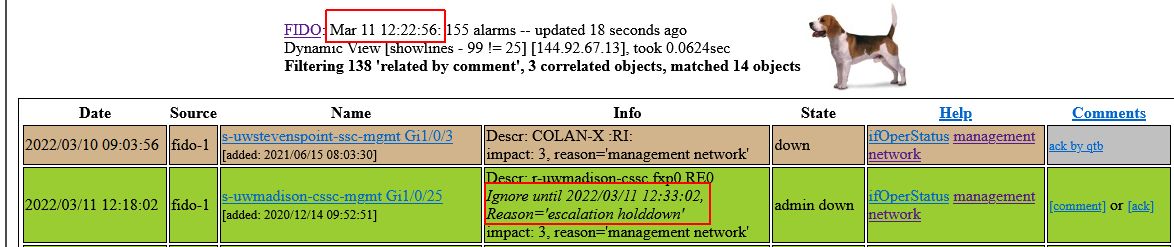
stage 2: alarm is out of holddown. Alarm should be appear "normal", for whatever "normal" means for said alarm. You'll note the alarm is now supported higher in the display, since it needs attention. Alarm should be actioned as appropriate
Configuration examples and details, see FIDO: generic alarm matching criteria and examples
Alarms are matched in many ways, either by the fully qualified alarm name, IP subnet, or alarm attribute. valid operators are 'undefined', 'defined', 'equal' or 'match' [perl regexp].
You can determine the fully qualified alarm name this for an active alarm by examining the FIDO database, accessible via the web or CLI, or for an old alarm by examining the CLI fido_events log. Here is an example of how you find the fully qualified alarm name from the fido_events.log file. The key/value pair of importance is the 'UnmodifiedItem' key/value.
Jan 14 10:35:03 nibbler fido.pl[15107]: {"_log_line":{"parent":"20140114.409","length":19,"unmodified_item":"s-ex4200-lab-24f.wiscnet.net jnxOperatingState Fan 1-jnxOperatingState","item":"s-ex4200-lab-24f.wiscnet.net jnxOperatingState Fan 1","action":"Add","_alarm_data":{"info":null,"failures":1,"test":"jnxOperatingState","event_id":"20140114.410","time":1389717284,"status":"OK","file":"snmp","device":"s-ex4200-lab-24f.wiscnet.net","state":"runningAtFullSpeed","iso":4,"snmp_instance":"4.1.1.1","updated":1,"needed_failures":"1","start":1389717284,"start_text":"2014/01/14 10:34:44"},"event":"20140114.410"}}