
Hazard Communication
What is Hazard Communication
Hazard Communication or HazCom, means that your employer must tell you what chemicals you are exposed to at work and how they affect your health and safety.
OSHA and the Wisconsin Department of Safety and Professional Services (DSPS) enforce and write rules on how employers tell you about these hazards.
In 2012, OSHA updated the HazCom Standard to follow the United Nations’ Globally Harmonized System of Classification and Labeling of Chemicals also known as GHS.
-
Required chemicals to be grouped together based on their physical and health hazards.
-
Standardized shipping labels for chemicals.
-
Created the Safety Data Sheet, a more detailed and standardized version of the previous Material Safety Data Sheet (MSDS).
-
See our Knowledge Base Page on SDSs!
What are the elements of HazCom and GHS?
Both have these six (6) elements:
-
Hazard identification and classification
-
Inventory or list of chemicals
-
Labels for chemicals
-
Safety Data Sheets (SDS)
-
Employee training
-
Written HazCom program.
Which items fall outside of the HazCom Standard?
-
Food, drugs, alcoholic beverages, tobacco products, and Cosmetics for an employee’s personal or medical use. This means use during or outside of work hours at a job site.
-
Medical & Veterinary Devices regulated by the FDA & USDA.
-
Hazardous waste as defined in the Solid Waste Disposal Act.
-
This also includes Universal waste such as:
-
Lamps and light bulbs (Ex. CFLs, halon, LEDs, etc.)
-
Mercury-containing equipment (Ex. thermostats, and switches)
-
Batteries (Ex. Lithium Ion, lead acid, etc.)
-
Hazardous substances being removed from a site following the Comprehensive Environmental Response, Compensation and Liability Act (CERCLA) (42 U.S.C. 9601 et seq.).
-
Food, Drugs, Cosmetics, and Medical Devices regulated under labeling requirements set by the FDA & USDA.
-
Nuisance particulates. The chemical manufacturer or importer must prove these to not cause physical or health hazard to workers for this to apply.
-
Biological hazards
-
Radiation (ionizing & non-ionizing)
What is a GHS Label?
All containers of hazardous chemicals must be labeled by the manufacturer or imported according to the recently revised Hazard Communication Standard and Globally Harmonized System of Classification and Labeling of Chemicals (GHS).
The label created and used by the manufacturer is called the shipping label. Chemicals that are transferred to secondary containers must also be labeled with a workplace label or GHS label.
Shipped containers are the original container for a product or chemical. They must be labeled with a GHS label.
Example of a GHS Shipping Label

A GHS Label must have all of these:
-
Name of the chemical or product
-
Signal word – these are “Danger”, “Warning” or “Caution”.
-
Hazard and precautionary statements
-
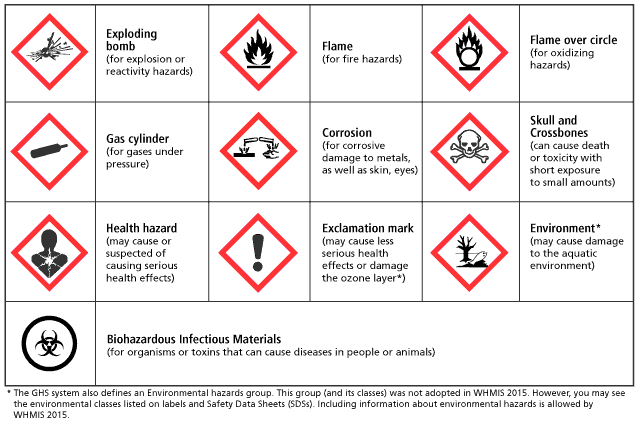
Pictograms describing hazards of the product
-
Contact information (name, address, telephone number) for the manufacturer, importer, or the party responsible.
Do I always need a GHS-compliant label?
You need them for original (shipped) containers, but there is some flexibility for secondary containers.
A secondary container is a container you fill up with the contents of the original (shipped) container. Some examples are spray bottles, jugs, gas cans, and buckets.
If you put chemicals into a secondary container, you must either use a GHS label or a Workplace label.

The workplace label must contain these things:
-
A description of a chemical’s physical and health hazards
-
This can be a combination of pictograms, warnings, or both.
-
The name and identity of the chemical.

Which items do not need HazCom labels?
Many items do not need HazCom-specific labels because different laws and regulations apply to them.
Some notable examples include consumer products, food and beverages. Below is a list of them from OSHA:
-
Pesticides following EPA labelling requirements under the Federal Insecticide, Fungicide, and Rodenticide Act (7 U.S.C. 136 et seq.)
-
Toxic Substances Control Act (15 U.S.C. 2601 et seq.) hazardous substances regulated by the EPA.
-
Alcohol products not for industrial use under the Federal Alcohol Administration Act (27 U.S.C. 201 et seq.) and following regulations.
-
Food, Drugs, Cosmetics, and Medical Devices regulated under labelling requirements set by the FDA & USDA.
-
Consumer products regulated by the Consumer Product Safety Commission.
-
Consumer Product Safety Act (15 U.S.C. 2051 et seq.)
-
Federal Hazardous Substances Act (15 U.S.C. 1261 et seq.)
-
Wood or wood products that have only flammability or combustibility hazard when sawed or cut or left unprocessed.
-
The chemical manufacturer or importer must prove this to be true if they treat a product with hazardous chemicals where HazCom requirements apply.